Showing posts with label cataloging. Show all posts

Tuesday, May 22, 2018

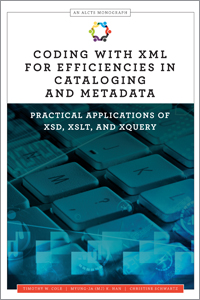
Coding with XML for Efficiencies in Cataloging and Metadata

https://www.alastore.ala.org/sites/default/files/book_covers/ALCTS_Cole_300_0.jpg

Cole, Timothy W., Myung-Ja K. Han, Christine Schwartz. Coding with XML for Efficiencies in Cataloging and Metadata. ALA Editions, 2018. ISBN:978-0-8389-1653-7

Description

This new handbook from the Association for Library Collections & Technical Services (ALCTS) provides guidance on creating metadata for sharing bibliographic records or digital collections on the web, with many examples of how to use XLML or XSLT scripting with library records. 

Table of Contents

Chapter 1    Introduction
Chapter 2    A Quick Review of XML Basics
Chapter 3    Library Metadata in XML
Chapter 4    XML Validation Using Schemas
Chapter 5    An Introduction to XPath and XSLT
Chapter 6    Cataloging Workflows Using XSLT
Chapter 7    Using XSLT to Connect Libraries to the Semantic Web: Transforming XML Metadata into HTML+RDFa
Chapter 8    An Introduction to XQuery for Library Metadata Work including Use Cases
Chapter 9    XQuery Basics
Chapter 10    XQuery Functions including Regular Expressions
Chapter 11    Metadata Workflow Using XQuery: Creating HathiTrust Submission Files for Monograph and Serials Print Holdings
Chapter 12    Resources for Further Study
Appendix A    Sample SPINE Metadata Record for an Emblem Book (discussed in Chapter 7)
Appendix B    XSLT for Creating Book-Level HTML+RDFa (discussed in Chapter 7)
Appendix C    XSLT for Creating Emblem-Level HTML+RDFa (discussed in Chapter 7)
Appendix D    Configurations for Working with XML, XSD, XSLT, and XQuery

Wednesday, June 21, 2017

Cataloging Library Resources: An Introduction


Cataloging Library Resources: An Introduction by Marie Keen Shaw. Rowman & Littlefield, 2017. 978-1-4422-7486-0.

Publisher's Description
While there are many cataloging texts, very few are written specifically for library support staff. This is the one and only book purposefully aligned with the new American Library Association – Library Support Staff Certification (LSSC) competency standards for Cataloging and Classification.

Written in clear language by someone who teaches cataloging in a library support staff program and featuring practical examples, Cataloging Library Resources: An Introduction will help library support staff become effective catalogers. Other books on this topic are written for professional librarians rather than support staff. And although 85% of library support staff do not hold professional degrees, many are expected to do the complex and technical work of catalogers. This book provides many examples that support staff can use to learn how to catalog all types of library print, media, and digital materials using the most up-to-date Library of Congress standards.

Using this handbook as a guide, readers will be able to perform the ALA-LSSC cataloging and classification competencies and the new RDA, FRBR, and BIBFRAME standards listed below:
  • Apply and manage the appropriate processes, computer technology, and equipment for cataloging and classification. 
  • Apply principles of Resource Description and Access (RDA) and the Functional Requirements for Bibliographic Records (FRBR) when creating cataloging records. 
  • Apply principles of the Bibliographic Framework Initiative (BIBFRAME) and utilize the BIBFRAME model to create cataloging records. 
  • Use the basic cataloging and classification tools, both print and online, including bibliographic utilities and format standards. 
  • Understand the value of authority control and its basic principles, and can identify and apply appropriate access points for personal names, corporate bodies, series, and subjects. 
  • Explain the value and advantages of cooperative or collaborative cataloging practices to enhance services. 
  • Know the basics of standard metadata formats and cataloging rules to select, review, and edit catalog records, and to generate metadata in various formats. 
  • And more!
More Information
See the publisher's website for Table of Contents, author information, and reviews.

Monday, February 13, 2017

Beginning Cataloging, 2nd Edition

Weihs, Jean and Sheila S. Intner. Beginning Cataloging. 2nd Edition. Libraries Unlimited, 2017. ISBN: 978-1-4408-3844-6

Description
Updated to include recent changes with RDA, this easy-to-use primer provides an introduction to standardized cataloging that will benefit library technicians as well as students in library technician and teacher librarian programs.

Table of Contents 

  1. Introduction
  2. Cataloging-in-publication
  3. Computer coding
  4. Descriptive cataloging
  5. Access points
  6. Subject headings
  7. Classification
  8. Copy Cataloging and Policy Issues
Appendix: Answers to Exercises
Glossary

Friday, December 9, 2016

Describing Music Materials


Smiraglia, Richard P. with Jihee Beak. Describing Music Materials: A Manual for Resource Description of Printed and Recorded Music and Music Videos. Fourth Edition. Rowman & Littlefield, 2017. ISBN: 978-1-4422-7628-4.

Description
This edition is rewritten to a large extent to conform to the new instructions and paradigms represented in Resource Description and Access (RDA). RDA instructions for printed music, recorded music and music video are accompanied by advice, examples, illustrations and complete catalog records, including versions in MARC21 format.

Table of Contents

1. Description of Printed Material

2. Description of Sound Recordings

3. Description of Music Video Recordings

4. Authorized Access Points


Glossary

Appendix: OCLC MARC21 Examples

Tuesday, October 18, 2016

Practical Ontologies for Information Professionals

Stuart, David. Practical Ontologies for Information Professionals.Chicago: ALA Neal Schuman,2016. 006.332 Stuar     ISBN978-0-83891511-0


More data and information is being created than ever before. Ontologies, formal representations of knowledge with rich semantic relationships, have become increasingly important in the context of today’s information overload and data deluge. The publishing and sharing of explicit explanations for a wide variety of concepts, in a machine readable format, has the power to both improve information retrieval and discover new knowledge. Information professionals are key contributors to the development of new, and increasingly useful, ontologies.

Practical Ontologies for Information Professionals provides an accessible introduction to the following:
·        defining the concept of ontologies and why they are increasingly important to information professionals;
·        ontologies and the Semantic Web;
·        existing ontologies, such as RDF, RDFS, SKOS, and OWL2;
·        adopting and building ontologies, showing how to avoid repetition of work and how to build a simple ontology;
·        interrogating ontologies for reuse; and
·        the future of ontologies and the role of the information professional in their development and use.

  • the future of ontologies and the role of the information professional in their development and use.More data and information is being created than ever before. Ontologies, formal representations of knowledge with rich semantic relationships, have become increasingly important in the context of today’s information overload and data deluge. The publishing and sharing of explicit explanations for a wide variety of concepts, in a machine readable format, has the power to both improve information retrieval and discover new knowledge. Information professionals are key contributors to the development of new, and increasingly useful, ontologies.
Practical Ontologies for Information Professionals provides an accessible introduction to the following:
  • defining the concept of ontologies and why they are increasingly important to information professionals;
  • ontologies and the Semantic Web;
  • existing ontologies, such as RDF, RDFS, SKOS, and OWL2;
  • adopting and building ontologies, showing how to avoid repetition of work and how to build a simple ontology;
  • interrogating ontologies for reuse; and
    the future of ontologies and the role of the information professional in their development and use.

Tuesday, March 1, 2016

Organizing Information

Houston, Cynthia. Organizing Information in School Libraries: Basic Principles and New Rules. Santa Barbara, CA: Libraries Unlimited, 2016. ISBN: 978-1-4408-3686-2

Publisher's Description
Covering both classification and cataloging principles as well as procedures relevant to school libraries, this book provides a teaching kit for a course on this critical subject that includes content and practice exercises.

A valuable resource for instructors in LIS programs who teach courses in cataloguing with an emphasis on school libraries, this textbook explains the nuts and bolts of classification and cataloging as well as the functionality of integrated library systems and how these systems critically serve the mission of the school. Author Cynthia Houston covers Web 2.0 and the social networking features of these systems as well as examining in detail the principles and procedures for subject classification using Sears subject headings or Dewey Decimal Classification using the Sears tool.

This teaching tool kit addresses the cataloging of print materials, audiovisual materials, and electronic materials separately—but all within the specific context of the school library. It supplies a number of examples and exercises to reinforce the key concepts and skills as well as to demonstrate the real-world applications of learning concepts and procedures. Based directly on Houston's extensive experience in teaching classification and cataloging courses, the included content and practice exercises enable instructors to use this book for content, for instruction, and for providing student feedback.

Features
  • Answers essential questions such as "What is the nature of the bibliographic universe in an electronic information age?" and "What is the relationship of my school library's catalog to the bibliographic universe?"
  • Addresses RDA standards as well as cataloguing and classification strategies for school library programs
  • Features practice exercises that readers can apply immediately for in-class use


Wednesday, February 10, 2016

Catalog It!

Kaplan, Allison G. Catalog It!: A Guide to Cataloging School Library Materials. 3rd ed. Santa Barbara, CA: Libraries Unlimited, 2015. ISBN: 978-1-4408-3580-3

Publisher's Description
Whether you're a practicing cataloger looking for a short text to update you on the application of RDA to cataloging records or a school librarian who needs a quick resource to answer cataloging questions, this guide is for you.

Since the last edition of this invaluable text was published, the library world has experienced a revolution in descriptive cataloging the likes of which has not been seen since the early 1980s. This updated, third edition of an established and well-respected guide makes it easy for you to stay in step with those monumental changes. The book will help you understand the latest fundamentals of cataloging so you can get items on the library shelves quickly and efficiently.

Every chapter has been revised. Changes in standards, including RDA and BISAC, that were alluded to in the second edition are discussed in depth and illustrated with explanations, and sample problem sets are included so you can put theory into practice. In addition, the book provides you with clear headings for easy scanning as well as cheat sheets and templates for creating records for book and non-book items. Previous editions of this text have been used by library practitioners and library and information science professors across the country because of its spot-on, easy-to-follow guidance on cataloging for school libraries. This new edition builds upon those strengths, adding everything you need to know about current, groundbreaking changes.

Features
  • Thoroughly updates a best-selling, essential guide to cataloging
  • Addresses the new standards specifically as they apply to school libraries
  • Helps school librarians understand and implement the new cataloging standards in their collections
  • Distills the latest information and presents it in a format that is clear and accessible
  • Fills the need for up-to-the-minute cataloging guidance for the busy librarian who wants information in a hurry

Monday, December 14, 2015

Introduction to Cataloging and Classification, 11th Edition.


Joudrey, Daniel N., Arlene G. Taylor, David P. Miller. Introduction to Cataloging and Classification. 11th Edition. Libraries Unlimited, 2015. ISBN: 978-59884-856-4


Description
This new edition of the classic cataloging textbook provides an introduction to descriptive cataloging based on contemporary standards, explaining the basic tenets to readers without previous experience, as well as to those who merely want a better understanding of the process as it exists today. The text opens with the foundations of cataloging, then moves to specific details and subject matter such as Functional Requirements for Bibliographic Records (FRBR), Functional Requirements for Authority Data (FRAD), the International Cataloging Principles (ICP), and RDA.  The book introduces MARC, BIBFRAME, and other approaches used to communicate and display bibliographic data. Discussions of formatting, presentation, and administrative issues complete the book; questions useful for review and study appear at the end of each chapter.

Table of Contents
PART I: INTRODUCTION
Chapter 1: Cataloging in Context
Chapter 2: Development of Catalogs and Cataloging Codes

PART II: DESCRIPTION AND ACCESS
Chapter 3: Underlying Principles and Conceptual Models
Chapter 4: RDA Basics
Chapter 5: Manifestations and Items
Chapter 6: Works and Expressions
Chapter 7: Persons, Families, Places, and Corporate Bodies
Chapter 8: Relationships and the Use of Access Points
Chapter 9: RDA Metadata in the MARC Format

PART III: AUTHORITY CONTROL
Chapter 10: Authority Control

PART IV: SUBJECT ACCESS
Chapter 11: Subject Access
Chapter 12: Verbal Subject Access
Chapter 13: Library of Congress Subject Headings (LCSH)
Chapter 14: Sears List of Subject Headings (SEARS)
Chapter 15: Other Verbal Access Systems
Chapter 16: Classification
Chapter 17: Decimal Classification
Chapter 18: Library of Congress Classification (LCC)
Chapter 19: Creation of Complete Call Numbers
Chapter 20: Other Classification Systems

PART V: FORMATTING AND PRESENTATION
Chapter 21: MARC Encoding
Chapter 22: Alternative Containers for Metadata
Chapter 23: International Standard Bibliographic Description (ISBD)

PART VI: ADMINISTRATIVE ISSUES
Chapter 24: Cataloging Management and Support
Appendix A: RDA Outline
Appendix B: ICC11 RDA Book Template
Glossary of Selected Terms and Abbreviations
Selected Bibliography
Index

Tuesday, November 17, 2015

FRBR, Before and After: A Look at Our Bibliographic Models

Coyle, Karen. FRBR, Before and After: A Look at Our Bibliographic Models. ALA Editions, 2016. ISBN: 978-0-8389-1345-1

Description
Coyle persuasively argues that to more effectively connect library users with books, movies, music, computer games, and other resources, library data needs to move beyond FRBR towards a more integrative approach to bibliographic models. But doing so requires fundamental changes in the approach to library data. She points the way ahead for catalogers and metadata specialists, providing clear explanations and analysis.

Table of Contents
Introduction 
Part I    Work, Model, Technology
1. The Work
2. The Model
3. The Technology
Part II    FRBR and Other Solutions
4. FRBR in Context
5. FRBR: Standard for International Sharing
6. The Entity-Relation Model
7. What Is Modeled in FRBR
8. Does FRBR Meet FRBR’s Objectives?
9. Some Issues that Arise
10. Bibliographic Description and the Semantic Web
11. Afterward

Wednesday, September 16, 2015

RDA: Resource Description and Access Print--2015 Revision

RDA: Resource Description and Access Print--2015 Revision. ALA, 2015. ISBN: 978-0-8389-1346-8

Description
This revision in complete through April 2015. For a full description, see the publisher's site:
http://www.alastore.ala.org/detail.aspx?ID=11507

Wednesday, September 2, 2015

Fundamentals of Technical Services


Sandstrom, John and Liz Miller. Fundamentals of Technical Services. Neal-Schuman, 2015. ISBN: 978-1-55570-966-2

Description
Written by librarians working and teaching on the front lines, this guide uses a functional, hands-on approach to lay out the basics of technical services, from acquiring new materials to making them available to library users. A good introduction for those just moving into the profession, or for library staff in need of a brush up!

Table of Contents

Chapter 1: Managing Technical Services
Chapter 2: Systems
Chapter 3: Collection Development
Chapter 4: Acquisitions
Chapter 5: Cataloging
Chapter 6: Physical Processing
Chapter 7: Authority Control and Catalog Maintenance
Chapter 8: Collection Management

Appendixes
A: Content Standards  
B: Classification Systems and Call Numbers
C: Subject Term Lists
D: MARC Digital Format

Friday, May 15, 2015

Rethinking Library Technical Services: Redefining Our Profession for the Future


Weber, Mary Beth (ed.) Rethinking Library Technical Services: Redefining Our Profession for the Future. Rowman & Littlefield, 2015. ISBN: 978-1-4422-3863-3

Description
What will technical services look like in thirty years, if it exists at all? This collection of essays from leading experts in the field of technical services takes a look at the future of the field.

Table of Contents
Chapter 1: The Future of Traditional Technical ServicesJulie Renee Moore and James L. Weinheimer  
Chapter 2: The State of Technical Services TodayMary Beth Weber  
Chapter 3: Metadata, MARC, and MoreSylvia Hall-Ellis 
Chapter 4: Restructuring Monograph Acquisitions in Academic Libraries: Innovative Strategies
for the Twenty-First Century
Michael Luesebrink 

Chapter 5: The Management of Electronic Resources: An OverviewAlice Crosetto 
Chapter 6: Research Data and Linked Data: A New Future for Technical Services?Sherry Vellucci 
Chapter 7: Skills for the Future of Technical ServicesErin E. Boyd and Elyssa Gould 
Chapter 8: Breaking Up Is Hard to Do: The End of Technical Services?: A Think Piece on the Future of Technical Services Amy Weiss  
Chapter 9: Interviews/feedback from the profession

Monday, April 6, 2015

Standard Cataloging


Intner, S. S., & Weihs, J. (2015). Standard Cataloging for School and Public Libraries (5th ed.). Santa Barbara, CA: Libraries Unlimited. ISBN: 978-1-61069-114-7

Publisher's Description
A proven resource for librarians and students, this updated classic opens the door to understanding current library cataloging processes, shows you how to use them to create standard catalog records, and provides guidance in managing the cataloging workflow.

Library cataloging and classification tools are constantly improving, making this concise guide a necessity for any librarian or library student seeking improved understanding of the practical process of cataloging today. With the release of RDA, a new code for description, and a new edition of Dewey Classification, it's time for every library to add this fifth edition of a classic reference to your resources. Two Margaret Mann Citation winners update you on the five basic steps in standardized library cataloging: describing and adding access points for resources; assigning subject headings using Sears List or Library of Congress subject headings; classifying them using the Dewey Decimal or Library of Congress classification systems; and digitizing the resulting records.

The book opens with a brief look at the environment in which cataloging now functions, especially in response to advances in digital access. It clarifies terminology, explores new and changed applications, and enhances understanding of basic principles for those responsible for creating cataloging data. To get you ready for tomorrow, the edition closes with a brief look at trends likely to affect cataloging in the foreseeable future.

Features
  • Describes today's new cataloging tools and shows how they are applied to real resources in various media, sharing numerous examples that illustrate the points raised
  • Explains the way library catalog records are produced for online catalogs
  • Describes MARC formats and explains how they relate to new metadata schemas such as MARC XML, the Dublin Core, and BIBFRAME
  • Discusses how to set goals and objectives, supervise others, evaluate outputs, and report to and interact with internal and external players in the world of libraries
  • Includes examples and illustrations of all tools and offers practice exercises to reinforce understanding

Table of Contents
Acknowledgments
Chapter 1: Introduction To Library Cataloging
Chapter 2: The Cataloging Environment
Chapter 3: Preparing Bibliographic Descriptions
Chapter 4: Name and Title Access Points
Chapter 5: Subject Analysis
Chapter 6: Subject Heading Authorities
Chapter 7: Library of Congress Subject Headings
Chapter 8: Sears List of Subject Headings
Chapter 9: Classification and Call Numbers
Chapter 10: Dewey Decimal Classification
Chapter 11: Library of Congress Classification
Chapter 12: Computer Encoding
Chapter 13: Managing the Catalog Department
Glossary
Answers to Chapter Questions
Appendix: Additional Exercises
Answers to Additional Exercises
Index

Wednesday, March 25, 2015

RDA Made Simple: A Practical Guide to the New Cataloging Rules


Hart, Amy. RDA Made Simple: A Practical Guide to the New Cataloging Rules. Libraries Unlimited, 2014. ISBN: 978-1-61069-485-8.

Description
This all-in-one guide to RDA keeps it simple and provides practical advice in applying the standard. It covers planning and training considerations, presents relevant FRBR and FRAD background, and offers practical, step-by-step cataloging advice for a variety of material formats.

Table of Contents
Introduction: RDA Made Simple
Chapter 1: RDA History to 2008
Chapter 2: RDA HIstory 2008alt-1-5-0
Chapter 3: Planning for RDA
Chapter 4: Implementation Issues
Chapter 5: FRBR, FRAD, and RDA
Chapter 6: RDA's Introductory Chapter
Chapter 7: Navigating RDA
Chapter 8: Tips for Using RDA
Chapter 9: The "RDA Into MARC" Workflow: An Overview
Chapter 10: RDA Section 1: Manifestations and Items
Chapter 11: RDA Section 2: Naming Works and Expressions
Chapter 12: Describing Content for Works and Expressions
Chapter 13: RDA Section 6: Relationships of a Resource to Persons, Families, or Corporate Bodies
Chapter 14: RDA Section 8: Resource-to-Resource Relationships
Chapter 15: RDA Sections 3 and 9: Authority Work
Chapter 16: RDA Quick Reference Table of Contents
Chapter 17: RDA Into MARC Overview: Quick-Ref Chart
Chapter 18: MARC Chart: RDA Impacts
Chapter 19: MARC 264 Fields and Publication Dates
Chapter 20: Content, Media, and Carrier Types in MARC 33x
Chapter 21: Collaborations and Compilations
Chapter 22: Note Fields in RDA
Chapter 23: RDA Examples
Bibliography
Index

Unlocking the Mysteries of Cataloging: A Workbook of Examples

Haynes, Elizabeth, Joanna F. Fountain, and Michele Zwierski. Unlocking the Mysteries of Cataloging: A Workbook of Examples. 2nd edition.  Libraries Unlimited, 2015. ISBN: 978-1-61069-5

Description
Ideal for students and both beginning and practicing catalogers in public, school, and academic libraries, this updated workbook offers targeted, hands-on exercises that enhance understanding of description, classification, subject analysis, subject heading application, and MARC 21 subject analysis.

Table of Contents
Introduction
Exercises 1-100
Appendix A: Selected Genre/Form Terms
Appendix B: MARC Records for Selected Exercises: AACR2r and RDA
Index to Exercises in Numerical Order
Index to Titles of Materials in the Exercises
Index to Types of Materials
Index to Topics, Themes, Etc. in the Exercises

Cataloging and Managing Film & Video Collections: A Guide to using RDA and MARC21


Higgins, Colin. Cataloging and Managing Film & Video Collections: A Guide to using RDA and MARC21. ALA Editions, 2015. ISBN: 978-0-8389-1299-7

Description
This handbook clarifies the RDA cataloging protocol for DVDs and Blu-ray discs, expanding upon established guidelines for AACR2 and integrating them into the new standard. Along the way, Higgins introduces the fundamentals of filmmaking, including its history and technical vocabulary, providing context that will help catalogers quickly find the information relevant to their bibliographic records.

Table of Contents
Introduction 

1 A Brief History of Film and Its Formats 
2 Production and Distribution, Cast and Crew 
3 Contents 
4 Technical Features 
5 Television 
6 Older and Unusual Formats 
7 MARC 21 Records and AACR2 
8 Managing the Collection 
9 Streaming Video and the Future of the Optical Disc

Further Resources

Appendices
A Sample Records
B Symbols Found on DVDs, Blu-ray Discs, and Their Cases

Monday, November 3, 2014

RDA: Resource Description and Access Print--2014 Revision


RDA: Resource Description and Access Print--2014 Revision. ALA, 2014. ISBN: 978-0-8389-1293-5.  

Description
Includes updates through April 2014. A full description can be found at the publisher's web site:
http://www.alastore.ala.org/detail.aspx?ID=11193

RDA and Cartographic Resources


Andrew, Paige G., Susan M. Moore, Mary Larsgaard. RDA and Cartographic Resources. ALA Editions, 2015. ISBN: 978-0-8389-1131-0

Description
Designed for both practicing map catalogers and catalogers new to cartographic resources, this volume will be a one-stop resource for all catalogers of cartographic materials looking to understand the differences between cataloging using AACR2 and cataloging using RDA.

Table of Contents

  1. The Past is Prologue
  2. RDA and FRBR Entities as Applied to Cartographic Resources: An Overview
  3. Comparing Standards: Continuing, Different, and Added Practices
  4. Navigating RDA to Describe Cartographic Resource Elements
  5. Cartographic Resources Cataloging: Moving Forward
Postscript


Appendixes
  • Image of Damietta Sheet from the Egpyt 1:100,000 Series
  • Map Record Example Showing FRBR Relationship Entities
  • RDA Checklist for Descriptive Elements
  • Examples of Correct Scale and Coordinates Notation in the 255 Field with Matching Examples in the 034 Field under AACR2 and RDA
  • 33X Content, Media, and Carrier Terms Examples Based on Different Kinds of Cartographic Resources
  • Digital Resources Notes: Comparing RDA Number with MARC Field Number
  • Sample Records for Different Cartographic Resources Types

Wednesday, October 15, 2014

Essential Classification

Essential classification

Broughton, Vanda. Essential Classification. New York: Neal-Schuman, Inc., 2004.  025.47 Broug2.  ISBN 978-1555705077

This book introduces novice catalogers to the practice of subject cataloging. Dealing with the fundamental questions of the purpose of classification and the needs and expectations of end users, the reader is introduced to the ways document content can be assessed and expressed for translation into the language of specific indexing and classification systems. The characteristics of the major schemes of classification and their suitability for different needs are discussed. The emphasis of all chapters is on the practical application of classification schemes, with coverage on: needs, purpose, and rightness of classification, document analysis and description, controlled indexing languages, concept and word based retrieval, structure and varieties of classification, management considerations, and more. This book is essential for all library school students and practicing librarians.

Wednesday, October 1, 2014

Essential Library of Congress Subject Headings


Broughton, Vanda. Essential Library of Congress Subject Headings. New York: Neal-Schuman, 2012.  025.47 Broug  ISBN: 9781555706401


Here's a crucial resource for anyone unfamiliar with Library of Congress Subject Headings. This book provides not only their background and history but also their advantages and their limitations. You'll learn the forms of entry, subject heading lists, main headings, compound headings, name headings, headings for literature, art, music, history and law, and subject headings in the online environment. No prior knowledge or experience of subject cataloguing is assumed. This is an indispensable guide to LCSH for practitioners and students alike.