Showing posts with label information literacy. Show all posts

Monday, June 18, 2018

Inspiring Curiosity


Cassinelli, Colette. Inspiring Curiosity: The Librarian's Guide to Inquiry-Based Learning. International Society for Technology in Education, 2018. ISBN: 978-1-56-484672-3

Note: The author is a teacher librarian at Sunset High School in Beaverton, Oregon.

Publisher's Description
Inspiring Curiosity is a practical guide for secondary school librarians as they collaborate with teachers and students to develop inquiry-based research projects. With success stories from librarians all over the U.S. illustrating how they’ve guided teachers and students through the research process, this book provides strategies for using memorable events to activate students’ natural curiosity and activities for generating essential questions for exploration.

The book includes:
  • Ideas and resources to help librarians be more effective in research and inquiry.
  • Tips for developing search strategies, locating and curating resources, evaluating sources and celebrating students’ inquiry beyond the traditional research paper.
  • Lessons and assessment ideas to keep librarians current on information literacy topics.
Written for librarians by a librarian, this book will help librarians collaborate with classroom teachers on inquiry projects and offers new ideas and insights to inspire them in the process.

Thursday, April 5, 2018

Implementing the Information Literacy Framework: A Practical Guide for Librarians

Implementing the Information Literacy Framework: A Practical Guide for Librarians by Dave Harmeyer and Janice J. Baskin. Rowman & Littlefield, 2018. 978-1-5381-0757-7.

Publisher's Description
Implementing the Information Literacy Framework: A Practical Guide for Librarians is written with three types of people in mind: librarians, classroom educators, and students. This book and its website address the implementation of the Association of College and Research Libraries’ Framework of Information Literacy in Higher Education. One of the few books written jointly by an academic librarian and a classroom faculty member, Implementing the Information Literacy Framework packs dozens of how-to ideas and strategies into ten chapters specifically intended for librarians and classroom instructors.

If you have been waiting for a no-nonsense, carefully explained, yet practical source for implementing the Framework, this book is for you, your colleagues, and your students, all in the context of a discipline-specific, equal collaboration between the library liaison and classroom educator. Implementing the Information Literacy Framework gives you the tools and strategies to put into practice a host of Framework-based information literacy experiences for students and faculty, creating a campus culture that understands and integrates information literacy into its educational mission.

More Information
See the item record for table of contents and author information.

Wednesday, December 20, 2017

The Fun of Motivation: Crossing the Threshold Concepts

The Fun of Motivation: Crossing the Threshold Concepts (Publications in Librarianship #71), by Mary Francis. ACRL, 2017. 978-0-8389-8933-3.

Publisher's Description
What’s the place of fun in education? When students learn something new, they reach a learning edge, a threshold, where learning becomes uncomfortable because the material is difficult or beyond their understanding. To avoid this discomfort, some students can simply fall back on what they already know. This is a critical point, because if they do not move beyond the edge, they are stuck with both limited knowledge and a negative feeling about learning. Fun can be used as a motivating technique to help students get past this learning edge, and to meet an established goal or learning objective.

The Fun of Motivation: Crossing the Threshold Concepts is organized into two parts—Part I examines the theories behind motivation and fun in the classroom, and offers three instructional techniques that highlight their benefits. Part II is the application of the theories explored in Part I, and its six chapters each address one of the threshold concepts provided in ACRL’s Framework for Information Literacy for Higher Education. Each chapter contains three lesson plans addressing the threshold concept, one for each of the three fun instructional techniques. Assessment opportunities are provided throughout, with formative assessment strategies as well as summative assessments, including sample rubrics to apply to a range of student work. Each lesson plan ends with a section on possible modifications and accommodations and additional ideas on how to adapt the lesson for different student populations.

The threshold concepts within the Framework need to be facilitated with deliberation by librarians integrating them into their instruction sessions. Students must be motivated to learn these concepts that help them master skills across disciplines. The Fun of Motivation can help you explore, implement, and assess this powerful means of motivation.

More Information
See the publisher's website for table of contents and information about the author.

Tuesday, December 12, 2017

Disciplinary Applications

Godbey, Samantha, et al., editors. Disciplinary Applications of Information Literacy Threshold Concepts. Association of College and Research Libraries, 2017. ISBN: 978-083898970-8

Publisher's Description
The definition of threshold concepts has been expanded over the years based on the work of many educational scholars and practitioners, but are essentially described as a portal, transition, or threshold to additional learning and deeper understanding for a learner. Threshold concepts are transformative, integrative, irreversible, bounded, and troublesome, and can be a valuable tool in both facilitating students’ understanding of their subject and aiding in curriculum development within the disciplines.

In 25 chapters divided into sections mirroring ACRL’s Framework for Information Literacy for Higher Education—Authority is Constructed and Contextual, Information Creation as a Process, Information has Value, Research as Inquiry, Scholarship as Conversation, and Searching as Strategic Exploration—Disciplinary Applications of Information Literacy Threshold Concepts explores threshold concepts as an idea and the specifics of what the concepts contained in the Framework look like in disciplinary contexts. The chapters cover many disciplines, including the humanities, social sciences, life sciences, and physical sciences, and a range of students, from first-year undergraduates to doctoral students.

Disciplinary Applications of Information Literacy Threshold Concepts provides a balance of theoretical and practical to help readers both conceptually and pragmatically with their work in supporting student learning, including chapters in which librarians have designed learning outcomes aligned with the frames of the Framework. These examples demonstrate different approaches to working with information literacy threshold concepts and how librarians are incorporating them within their disciplinary and institutional contexts. As Ray Land says in the Foreword, “This volume marks a significant new departure in the development of the threshold concepts analytic framework.”


Table of contents

Thursday, October 19, 2017

Librarians With Spines


Cura, Y. S., & Macias, M. (Eds.). (2016). Librarians With Spines: Information Agitators In An Age of Stagnation. Los Angeles, CA: CreateSpace. ISBN: 9780984539888.

Summary

Librarians with Spines is an anthology of 9 essays written by 11 radical librarians pushing the boundaries of social justice community service, library and information science, equitable bibliographic taxonomy, and ubiquitous information literacy. Co-edited by Max Macias and Yago Cura, illustrated and designed by Autumn Anglin, and published by HINCHAS Press, this array of minority and queer voices in librarianship and intelligent political art seeks to affirm the importance of innovative, courageous librarians facilitating effective programming and initiatives. Completely funded by a successful GoFundMe campaign and beholden to no organization, committee, nor clique, authors include Jason Alston, Anthony Bishop, Candise Branum, Cathy Camper, A'misa Chiu, Loida Garcia-Febo, kYmberly Keeton, Diane Lopez, Kael Moffat, Mary Rayme, and Aquita Winslow. Topics range from Critlib management to the importance of ethnic caucuses, from zine librarianship to prison librarianship to Hip Hip Information Literacy.

Monday, July 24, 2017

Learner-Centered Pedagogy: Principles and Practice


Learner-Centered Pedagogy: Principles and Practice by Kevin Michael Klipfel and Dani Brecher Cook. ALA Editions, 2017, 978-0-8389-1557-8.

Publisher's Description
Today’s emphasis on metrics and personalization make evidence-based instruction an imperative. In this practice-based handbook, the authors draw on the research of the humanistic psychologist and educator Carl Rogers to present an empathetic approach to information literacy sessions, reference service, and outreach.  With an eye on everyday library work, they offer concrete, empirically-based strategies to connect with learners at all levels. Offering plentiful examples of pedagogy in action, this book covers:
  • 6 cognitive principles for organizing information literacy instruction, with sample worksheets and organization tools for instruction planning;
  • how to establish rapport and kindle learners’ motivation;
  • tactics for transcending “cite 5 sources” and other uninspiring research assignments;
  • educational evidence debunking the mythical perception that because students are skilled at computers and mobile technology, they already know how to do research;
  • questions to keep in mind for inspiring autonomous learning;
  • the power of story, as described by Joan Didion, BrenĂ© Brown’s Ted Talk, and educational psychology research;
  • the science behind information overload; and
  • a balanced framework for evaluating specific educational technology tools.
Fusing theory with practice, this handbook is a valuable resource to help every practitioner connect with learners more effectively.

The authors blog at Rule Number One: A Library Blog.

More Information
See the publisher's website for Table of Contents and author information.

Wednesday, July 12, 2017

Not Just Where to Click: Teaching Students How to Think about Information


Swanson, Troy A. and Heather Jagman (eds). Not Just Where to Click: Teaching Students How to Think about Information. Chicago, Illinois : Association of College and Research Libraries, a division of the American Library Association, 2015. ISBN: 978-0-8389-8716-2.

(Winner of the 2016 ACRL Instruction Section Ilene F. Rockman Award)

Not Just Where to Click: Teaching Students How to Think about Information explores how librarians and faculty work together to teach students about the nature of expertise, authority, and credibility. It provides practical approaches for motivating students to explore their beliefs, biases, and ways of interpreting the world.

This book also includes chapters that bridge the gap between the epistemological stances and threshold concepts held by librarians and faculty, and those held by students, focusing on pedagogies that challenge students to evaluate authority, connect to prior knowledge and construct new knowledge in a world of information abundance. Authors draw from a deep pool of perspectives including social psychology, critical theory, and various philosophical traditions.

Contributors to the nineteen chapters in this volume offer a balance of theoretical and applied approaches to teaching information literacy, supplying readers with accessible and innovative ideas ready to be put into practice.

Not Just Where to Click is appropriate for all types of academic libraries, and is also suitable for library and information science curricula and collections.

Complete table of contents are available here.

Friday, May 26, 2017

Reading, Research, and Writing: Teaching Information Literacy with Process-Based Research Assignments


Reading, Research, and Writing: Teaching Information Literacy with Process-Based Research Assignments by Mary Snyder Broussard. ACRL, 2017. 978-0-8389-8875-6.

Publisher's Description
The research paper has become so ingrained in higher education that its benefits are assumed to be self-evident, but the connection between student writing and learning is not always clear. Educators frequently discuss the lack of critical thinking demonstrated in undergraduate research papers, but it may not be that students will not invest in writing assignments—it’s possible that many cannot with the educational support currently provided.

Through theory and examples, and with ACRL’s Framework for Information Literacy for Higher Education integrated throughout, Reading, Research, and Writing: Teaching Information Literacy with Process-Based Research Assignments shows just how difficult research assignments can be for novice learners, and offers concrete plans and approaches for building assignments that enhance student learning.

In six chapters—including a final chapter on turning theory into practice—Reading, Research, and Writing is an in-depth, interdisciplinary look at the literature in rhetoric and composition studies, reading comprehension, cognitive psychology, education theory, and library and information science that captures what academic librarians and their teaching faculty collaborators should know about reading and writing to improve undergraduate writing-from-sources assignments. The implications for such an understanding include improving students’ motivation to research, analyze, and synthesize information at a deeper level; improving librarians’ ability to influence effective assignment design among teaching faculty; and opening new avenues of meaningful formative assessment in library instruction.

Information literacy and writing-from-sources are important skills for college graduates who leave formal education to be professionals and, hopefully, lifelong learners. Librarians must examine the broader picture that their piece fits within and work across disciplines to produce truly literate—and therefore information-literate—college graduates.

More Information
See the publisher's website for Table of Contents and author information.

Monday, April 10, 2017

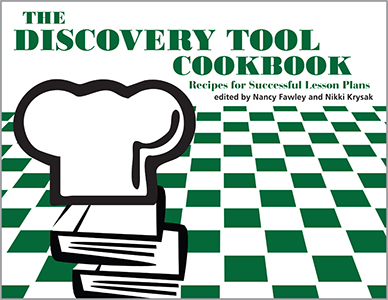
The Discovery Tool Cookbook


The Discovery Tool Cookbook: Recipes for Successful Lesson Plans, edited by Nancy Fawley and Nikki Krysak. ACRL, 2016. 978-0-8389-8891-6.

Publisher's Description
The Discovery Tool Cookbook: Recipes for Successful Lesson Plans, edited by Nancy Fawley and Nikki Krysak, showcases tested lessons by librarians and practitioners for teaching information literacy using a discovery tool. The third volume in the successful ACRL Cookbook series features “recipes” sorted by lesson type and level of student preparedness, including all the information needed to replicate (or customize) each dish at your own institution. The IL Framework is infused in each of the 49 lessons, which suit a mix of abilities, learning outcomes, and patron types, including K-12 and ELL students, with options for flipping instruction to maximize learning outside of the classroom.

The Discovery Tool Cookbook is essential for all academic and school librarians wanting to create fun lesson plans that incorporate a discovery layer.

More Information
See the publisher's website for Table of Contents and editor information.

Wednesday, March 29, 2017

The First-Year Experience Cookbook

The First-Year Experience Cookbook, edited by Raymond Pun and Meggan Houlihan. ACRL, 2017. 978-0-8389-8920-3.

Publisher's Description

First-year students face many challenges in adjusting to university life, including making the most of the university library. Librarians are constantly addressing student misconceptions about libraries and locating information, and have been working hard to reach first-year students and create high-impact practices in student retention.

The First-Year Experience Cookbook provides librarians with a series of innovative approaches to teaching and assessing information literacy skills during a student’s first year. Featuring four chapters—Library Orientation, Library Instruction, Programs, and Assessment—and more than 60 practical, easy-to-implement recipes, this book compiles lessons and techniques for you to adapt, repurpose, and implement in your libraries.

This Cookbook is essential for all academic and school librarians looking for ideas on how to infuse the ACRL Framework for Information Literacy for Higher Education in their first-year courses and instruction; design and assess effective services and programs; and engage and retain students.

More Information

See the publisher's website for Table of Contents and editor information.

Wednesday, February 15, 2017

The Craft of Librarian Instruction: Using Acting Techniques to Create Your Teaching Presence

The Craft of Librarian Instruction: Using Acting Techniques to Create Your Teaching Presence, by Julie Artman, Jeff Sundquist, and Douglas R. Dechow. ACRL, 2016. 978-0-8389-8821-3.

Publisher's Description
Library instruction is like a theatre performance. You play a role as the instruction librarian. There is a live audience. You may receive reviews or evaluations. Or maybe the teaching experience feels more like an audition—a bit unnerving! In The Craft of Librarian Instruction: Using Acting Techniques to Create Your Teaching Presence, join Julie Artman, Jeff Sundquist, and Douglas R. Dechow for a fun and creative approach to library instruction as they demonstrate how acting techniques can hone your presentation skills, your teaching style, and your performance to create an invigorating (and stress-free) learning experience for your students.

Using acting methods and techniques, you’ll learn how to:
  • Rehearse and prepare for your instruction session by centering yourself through visualization, memorization, and improvisation;
  • Connect with your students through personalization and role-playing, and by exploring your teacher identity; and
  • Sharpen your unique teaching presence through reflection and intentional instruction.
Vocal and physical preparation and instructional scenarios will reveal potential challenges and pose solutions, and provide tips for deepening your teaching skills. Intended for newly hired instruction librarians, librarians with little or no teaching experience, those dealing with shyness or ‘stage fright,’ as well as more experienced librarians in need of a refreshed perspective, The Craft of Librarian Instruction: Using Acting Techniques to Create Your Teaching Presence will add an undeniable star quality to your instructional performance!

More Information
See the publisher's website for Table of Contents and information about the authors.

Tuesday, February 7, 2017

Emerging Strategies for Supporting Student Learning

Emerging Strategies for Supporting Student Learning: A Practical Guide for Librarians and Educators by Barbara Allan. Facet Publishing, 2016. 978-1-78330-070-9.

Publisher's Description
The higher education landscape is rapidly evolving due to changes in the student population (millenials, increasing diversity, changing work habits), technology (the rise in the use of social media) and learning spaces (the increase in physical and virtual social learning spaces).  Allan presents the first book to bring together recent developments in both theory and practice, covering a wide range of tools and techniques which will suit students in different contexts, from large groups of 500+ to very small classes of research students. Making extensive use of case studies, examples, checklists, and tables, this practical book contains:
  • an analysis of the current higher education landscape, the changes that are occurring and the diverse nature of student populations;
  • an exploration of new theories of digital literacy including case studies demonstrating how library and information workers have applied these models in practice;
  • a demonstration of the many different ways in which academic library and information services are working in support of student employability;
  • a theoretical overview of different approaches to teaching and learning including Kolb's learning cycle, Laurillard's conversational framework for university teaching, Entwistle's teaching for understanding at university, Land and Meyer's threshold concepts and the Higher Education Academy's work on flexible pedagogies;
  • practical guidance on designing, developing and evaluating courses and other learning and teaching events in different situations including face-to-face, flipped classroom, blended learning, and online learning; and
  • an exploration of approaches to personal and professional development including 90+ approaches to workplace learning; accredited courses; short courses, conferences and workshops; networking through professional organizations; and developing online networks.
This book will be essential reading for different groups working in colleges and universities including library and information workers, staff developers, educational technologists, educational development project workers, educational change agents and students of library and information science who are planning their careers in higher education institutions.

More Information
See the publisher's website for Table of Contents, information about the author, and to read a sample of the book.

Tuesday, December 13, 2016

The New Instruction Librarian


The New Instruction Librarian: A Workbook for Trainers and Librarians, by Candice Benjes-Small and Rebecca K. Miller. ALA Editions, 2017. 978-0-8389-1456-4.

Publisher's Description
The sheer amount of resources on the subject of information literacy is staggering. Yet a comprehensive but concise roadmap specifically for librarians who are new to instruction, or who are charged with training someone who is, has remained elusive. Until now. This book cuts through the jargon and rhetoric to ease the transition into library instruction, offering support to all those involved, including library supervisors, colleagues, and trainees.  Grounded in research on teaching and learning from numerous disciplines, not just library literature, this book:
  • shows how to set up new instruction librarians for success, with advice on completing an environmental scan, strategies for recruiting efficiently, and a training checklist;
  • walks readers step by step through training a new hire or someone new to instruction, complete with hands-on activities and examples;
  • explores the different roles an instruction librarian is usually expected to play, such as educator, project manager, instructional designer, and teaching partner;
  • demonstrates the importance of performance evaluation and management, including assessment and continuing education, both formal and informal; and
  • provides guided reading lists for further in-depth study of a topic.
A starter kit for librarians new to instruction, this resource will be useful for training coordinators as well as for self-training.

Check out this book’s Web Extra now!

More Information
See the publisher's website for Table of Contents and information about the authors.

Creating and Promoting Lifelong Learning in Public Libraries


Gilton, Donna L. Creating and Promoting Lifelong Learning in Public Libraries: Tools and Tips for Practitioners. Rowman & Littlefield, 2016. ISBN: 978-1-4422-6952-1 

Description
This book describes basic steps that librarians can execute in order to get started with lifelong learning programming, using ideas from informal and nonformal education in museums, community organizations and agencies. Chapters include on planning for instruction, using teaching methodologies, teaching with and about technology, and bringing information literacy standards together with more traditional public library services, programming, and activities, such as reference and Readers’ Advisory services, bibliotherapy, and cultural and literacy programming.


Table of Contents
1.What Creating and promoting lifelong learning in public libraries is all about.
  • Planning modes and instructional models
  • Scope and organization
  • Notes
2. Planning for formal instruction.
  • Decision points
  • ILI planning for the whole library
  • Preparing to teach
  • Notes
3. Teaching methodologies.
  • Lectures
  • Active learning in the classroom
  • Games and gaming
  • Applying active learning to real life
  • Universal design of learning, instruction, and information literacy
  • Toward evaluation
  • Notes
4. Implementing instruction with technology.
  • Web 1.0
  • Web 2.0
  • Combining Web 1.0 and 2.0
  • Notes
5. Connecting information literacy to other lifelong learning in public libraries.
  • Lifelong learning, adult education, and independent learning reference encounters and research consultations, off- and online
  • Readers' advisory services
  • Bibliotherapy
  • Cultural and literacy programming
  • Lifelong learning and public libraries : tying it all together
  • Notes
Conclusion: ILI futures.
  • More technologies, more complex technologies
  • Changes in standards
  • Other literacies
  • Implication, application, and remaining questions
  • Notes

Thursday, December 8, 2016

Information and Digital Literacies


Farmer, Lesley S. J. Information and Digital Literacies A Curricular Guide for Middle and High School Librarians. Rowman & Littlefield, 2015. ISBN: 978-1-4422-3981-4

Publisher's Description
Information and Digital Literacies: A Curricular Guide for Middle and High School Librarians is a practical guide to help school librarians design and deliver effective instruction that addresses the knowledge, skills and dispositions of information and digital literacies.

This curricular guide from one of America’s foremost experts in this area will help librarians prepare students for college and careers. It provides systematic instruction about conducting research and using integration as stated in the Common Core, complying with state and federal mandates for digital safety/competence curriculum, and recognizing the instructional role of school librarians. It should be noted that “canned” programs, particularly for digital safety exist, but they are not aligned with other school standards, and they do not reflect the unique communities of learners, let alone address the need to collaboration and articulation.

The ready-to-implement curricular guide features:
  • instructional design strategies,
  • model middle and high school curriculum, including a scope-and-sequence, stand-alone courses, units of instruction, and sample learning activities, and
  • ties to new AASL and ACRL information literacy standards, ISTE technology standards, 21st Century Partnership framework, and Common Core State Standards.
Table of contents

Monday, November 28, 2016

Rewired: Research-Writing Partnerships within the Frameworks

Rewired: Research-Writing Partnerships Within the Framework, edited by Randall McClure. Association of College and Research Libraries, 2016. 978-083898904-3.

Publisher's Description
Colleges and universities tend to be siloed spaces where we work within our own departments, divisions, and units and don’t always recognize the connections we have with the work of our colleagues down the hall. Rewired: Research-Writing Partnerships within the Frameworks highlights the clear connections between two important disciplinary documents—the Framework for Success in Postsecondary Writing (CWPA, NCTE, and NWP, 2011) and the Framework for Information Literacy for Higher Education (ACRL, 2016)—and examines partnerships between librarians and their colleagues who are teaching information literacy in new and impactful ways.

Researching and writing are inseparable and interdependent processes, even in activities without a required research/source use component. From disciplines and areas one would expect—English departments, first-year writing programs, and university writing centers—to those perhaps more unexpected, such as the health sciences, courses in music, and summer bridge programs, Rewired features partnerships within a range of institutional types that have built upon the connections between these Frameworks in ways that construct meaningful relationships for students as they develop expertise in research-writing.

The chapters in Section 1, Developing a Shared Understanding, show off the ways we can learn from each other’s expertise when we engage in conversation and break down the disciplinary silos that tend to separate us. The range of curricular reforms at institutions across the country showcased in Section 2, Partnering Research & Writing, offer multiple options for how partnerships between faculty members invested in writing in the disciplines and their librarian colleagues might develop in different kinds of institutional contexts. And finally, Section 3, Assessing Writing & Information Literacy, challenges us to think about how we assess students’ research-writing development and the impact of the partnerships we develop.

College and research librarians have of course been working alongside professors invested in writing in the disciplines for decades. What is new about these partnerships is how faculty members and librarians are re-imagining their work, rewiring it if you will, for students in a world where writing is both global and largely digital.

More Information
See the publisher's website for Table of Contents and information about the editor.  

Tuesday, October 25, 2016

Critical Library Pedagogy

Pagowsky, N., & McElroy, K. (Eds.). (2016). Critical Library Pedagogy Handbook (Vols. 1 & 2). Chicago, IL: Association of College and Research Libraries. ISBN: 978-0-8389-8917-3

Publisher's Description
Critical pedagogy incorporates inclusive and reflective teaching for aims of social justice; it provides mechanisms for students to evaluate their social, political, and economic standing, and to question societal norms and how these norms perpetuate societal injustices. Teaching librarians have long incorporated social justice into their work, but focused interest in critical library pedagogy has grown rapidly in recent years.

In two volumes, the Critical Library Pedagogy Handbook works to make critical pedagogy more accessible for library educators, examining both theory and practice to help the busy practitioner explore various aspects of teaching for social justice.

Volume One, Essays and Workbook Activities, provides short essays reflecting on personal practice, describing projects, and exploring major ideas to provide inspiration as you begin or renew your exploration of critical pedagogy. The bibliography of each chapter provides a network of other sources to explore, and the volume closes with a selection of workbook activities to improve on your own practice and understanding of critical pedagogy.

Volume Two, Lesson Plans, provides plans covering everything from small activities to multi-session projects. Critical pedagogy requires collaborating with learners and adapting to their needs, as well as continual reflection, but these lessons provide elements you can pull and tweak to fit your own environment. These chapters also provide 30 different views on creating and delivering critically designed information literacy instruction and reflect material commonly requested by faculty—including introductions to databases, evaluating information sources, and the research cycle. 

Wednesday, October 5, 2016

One-Shot Library Instruction Survival Guide, Second Edition

The One-Shot Library Instruction Survival Guide, Second Edition by Heidi E. Buchanan and Beth A. McDonough. ALA Editions, 2017. 978-0-8389-1486-1.

Publisher's Description
The ACRL Framework for Information Literacy for Higher Education is good news for one-shot instructors. With its six frames and conceptual approach you’re freed from a long list of outcomes and can instead focus on big ideas. The new edition of this concise guide will help you stay organized and use your limited time wisely. With guidance that will help students sharpen their critical thinking skills, use better sources, improve their understanding, and avoid plagiarism, this book covers
  • creative solutions for real-life problems, such as a difficult assignment or controversial topic, illustrated with 13 vignettes from professionals in the field;
  • efficient assessment despite limited time or resources;
  • specialized settings like an online class or classroom without computers;
  • practical ideas on instruction for the six frames;
  • choosing the right lesson for the right student at the right time;
  • how to use concept maps; and
  • creating assignments for active learning and experiential learning.
Filled with strategies to guide students towards meeting instructors’ expectations for critical thinking, this resource will also empower librarians to become better, more confident teachers.

More Information
See the publisher's website for Table of Contents and information about the authors.

Tuesday, August 23, 2016

Librarians and Instructional Designers

Eshleman, Joe, et al. Librarians and Instructional Designers: Collaboration and Innovation. Chicago: ALA, 2016.
ISBN: 978-0-8389-1455-7

Publisher's Description
With online education options more ubiquitous and sophisticated than ever, the need for academic librarians to be conversant with digital resources and design thinking has become increasingly important. The way forward is through collaboration with instructional designers, which allows librarians to gain a better understanding of digital resource construction, design, goals, and responsibilities. In this book, the authors demonstrate that when librarians and instructional designers pool their knowledge of curriculum and technology, together they can impact changes that help to better serve faculty, students, and staff to address changes that are affecting higher education. Illustrated using plentiful examples of successful collaboration in higher education, this book
  • introduces the history of collaborative endeavors between instructional designers and librarians, sharing ideas for institutions of every size;
  • reviews key emerging issues, including intellectual property, digital scholarship, data services, digital publishing, and scholarly communication;
  • addresses library instruction, particularly the new information literacy framework and threshold concepts, and how the movement towards online library instruction can be supported through collaboration with instructional designers;
  • describes the complementary roles of librarians and instructional designers in detail, followed by a case study in collaboration at Davidson College, an evolving digital project that mirrors changes in technology and collaboration over more than a decade;
  • shows how librarians and instructional designers can work together to encourage, inform, train, and support both faculty and students in the use of digital media, media databases, online media, public domain resources, and streaming media tools;
  • highlights creative opportunities inherent in the design and use of the Learning Management System (LMS); and
  • looks ahead to how emerging technologies are already leading to new jobs at the intersection of librarianship and technology, such as the instructional design librarian.
With a firm foundation on best practices drawn from a variety of institutions, this book maps out a partnership between academic librarians and instructional designers that will lead to improved outcomes. 

Table of Contents
See the publisher's website.


Thursday, August 11, 2016

The Big 6 Curriculum

Eisenberg, Michael B., Janet Murray, and Colet Bartow. The Big 6 Curriculum: Comprehensive Information and Communication Technology (ICT) Literacy for All Students. Santa Barbara, CA: Libraries Unlimited, 2016. ISBN: 978-1-4408-4479-9

Publisher's Description
This practical, hands-on book explains how to ensure that your students are information and communication technology literate—that is, competent with a range of tools, technologies, and techniques for seeking out and applying information.

The importance of teaching information and communication technology (ICT) literacy is clear: without it, students will be ill-equipped to find and use information in all its forms as well as produce and present information in all forms. Unfortunately, most ICT literacy educational programs are irregular, incomplete, or arbitrary. Classroom teachers, teacher librarians, and technology teachers need a complete ICT program—one with clearly defined goals and objectives, planned and coordinated instruction, regular and objective assessment of learning, and formal reporting of results. This book explains how to integrate the objectives of ICT literacy into your school's established curricular structure.

The book explains the rationale for a having a comprehensive ICT program, describes how to develop a Big6 by the Month program, and defines the challenges in the areas of information-seeking strategies, location and access, use of information, synthesis, and evaluation. It also includes templates for grade-level objectives; a scenario plan, program plan, lesson plan, and unit plan; summary evidence and criteria; performance descriptors; a presentation readiness checklist; and Big6 by the Month checklists for instructional leaders, teachers, and teacher librarians.

Features
  • Helps librarians better understand and implement the information and communication technology (ICT) skills required of 21st-century students
  • Presents dozens of figures, templates, and lessons to aid librarians in implementing comprehensive ICT literacy programs that reach all students in all schools
  • Provides highly relevant concepts for librarians at all schools or districts seeking to achieve local, state, or Common Core educational standards
Table of Contents
See the publisher's website