Monday, April 16, 2018

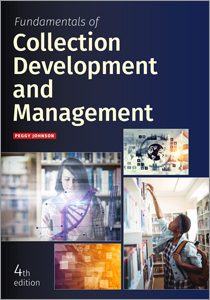
Fundamentals of Collection Development and Management, Fourth Edition


Johnson, Peggy. Fundamentals of Collection Development and Management. Fourth Edition. ALA Editions, 2018. ISBN: 978-0-8389-1641-4

Description
An essential textbook on the topic of collection development and management, this new edition has been revised and freshened to ensure its timeliness and continued excellence. Each chapter offers complete coverage of one aspect of collection development and management, including numerous suggestions for further reading and narrative case studies exploring the issues.

Table of Contents 
1    Introduction to Collection Development and Management
  • Components of Collection Development and Management
  • Historical Overview
  • Theories of Selection
  • Future of Collection Development and Management
  • Notes
  • Suggested Readings
2    Organizational Models, Staffing, and Responsibilities
  • Collection Management and Development Responsibilities
  • Assignment of Responsibilities
  • Skills and Competencies
  • Learning after School
  • Organizational Models
  • Ethical Issues
  • Notes
  • Suggested Readings
3    Planning, Policy, and Budgets
  • Planning in Libraries
  • Planning Models
  • Environmental Scanning
  • Why Undertake Formal Planning?
  • Collection Development Policy Statements
  • Writing the Collection Development Policy Statement
  • Budgeting and Finance
  • Notes
  • Suggested Readings
4    Developing Collections
  • Universe of Published Materials
  • The Selection Process
  • Notes
  • Suggested Readings
5    Vendor Relations, Negotiation, and Contracts
  • Overview
  • Vendor Relations
  • Negotiation
  • Contracts
  • Notes
  • Suggested Readings
6    Managing Collections
  • Weeding
  • Storage
  • Preservation and Conservation
  • Review and Cancellation of Continuing Resources
  • Collection Protection and Security
  • Notes
  • Suggested Readings
7    Marketing, Liaison Activities, and Outreach
  • Understanding Marketing
  • Marketing Concepts
  • Managing the Marketing Cycle
  • Liaison and Outreach Activities
  • Social Media
  • Notes
  • Suggested Readings
8    Collection Analysis, Accountability, and Demonstrating Value
  • Collection Analysis as a Management Tool
  • Historical Overview of Collection Analysis
  • Approaches to Collection Analysis
  • Electronic Resources and Collection Analysis
  • Methods of Collection-Based Analysis
  • Methods of Use- and User-Centered Analysis
  • Cost-Benefit Analysis, Social Return on Investment, and Balanced Scorecards
  • Conducting the Analysis and Preparing a Collection Analysis Report
  • Notes
  • Suggested Readings
9    Collaborative Collection Development and Management
  • Overview
  • Resource Sharing
  • Bibliographic Access
  • Coordinated or Collaborative Collection Building and Management
  • Infrastructures for Cooperative and Collaborative Collection Development and Management
  • Attributes of Successful Consortia
  • Challenges to Collaborative Collection Development and Management
  • Evaluating Collaborative and Cooperative Collection Development and Management
  • Notes
  • Suggested Readings
Appendix A    Professional Resources for Collection Development and Management
Appendix B    Selection Aids

Glossary

Managing and Improving Electronic Thesis and Dissertation Programs: A Practical Guide for Librarians

Managing and Improving Electronic Thesis and Dissertation Programs: A Practical Guide for Librarians by Matthew C. Mariner. Rowman & Littlefield, 2018. 978-1-5381-0100-1.

From the publisher:
Managing and Improving Electronic Thesis and Dissertation Programs: A Practical Guide for Librarians presents strategies for collecting and managing both traditional and non-traditional theses and terminal projects.

This guide covers:
  • collecting and managing traditional ETDs
  • beginning and managing retrospective digitization projects
  • improving the usability of current ETD programs
  • addressing complex and unique nontraditional theses and capstones and maximizing their accessibility
  • incorporating ETD collections into broader plans for marketing digital repositories
This guide provides readers with illustrated project workflows, real-world case studies, project starters for nontraditional theses, tips and advice on authors' rights, and helpful resources for further study and assistance. With this book, readers will have what they need to successfully navigate the world of electronic theses and dissertations.


Friday, April 13, 2018

Applying Library Values to Emerging Technology

Applying Library Values to Emerging Technology: Decision-Making in the Age of Open Access, Maker Spaces, and the Ever-Changing Library by Peter D. Fernandez and Kelly Tilton. Association of College and Research Libraries, a division of the American Library Association, 2018. ISBN: 978-0-8389-8939-5.

Every year, emerging technologies are more deeply integrated into libraries and the lives of the users they serve. These technologies are not simply neutral tools—they come embedded with their own sets of assumptions and values. As users and creators of technologies, as well as institutions that are part of the fabric of their communities, libraries must uphold the values of the profession—values that are often in tension with one another, and with the values embedded in the technology that is available—while effectively meeting the evolving needs of their users.

Applying Library Values to Emerging Technology: Decision-Making in the Age of Open Access, Maker Spaces, and the Ever-Changing Library offers a wide range of perspectives on how to interpret and apply library values in the context of emerging technologies. Authors include academic librarians, public librarians, and professors, and contributors from the Library Freedom Project, the Institute of Museum and Library Services (IMLS), the Free Ebook Foundation, Creative Commons, the Electronic Frontier Foundation, the Tor Project, the Center for Information Policy Research, and the Institute for the Study of Knowledge Management in Education. Divided into two sections—Contemplating Library Values and Applying Library Values—and using the ALA’s Core Values of Librarianship as the primary reference point, chapters emphasize the underlying frameworks that guide librarian practice and capture practical, real-world applications that can ideally serve as a starting point for other librarians encountering similar issues, even if the specific technology or set of values may differ.

The technology that libraries utilize will inevitably help define the library, its patrons, and, through them, the world. Many of the issues raised here do not have easy answers. Values are meant to endure the test of time but must interact appropriately with the immediate challenge, the larger society, and the reality of the technological options available. Libraries must actively engage with the implications of their values, informed by their particular context. Applying Library Values to Emerging Technology will help all librarians develop a more nuanced understanding of both the technology and the profession’s values, and help ensure that our values are realized in our decisions.

Reading Still Matters: What the Research Reveals about Reading, Libraries, and Community

Reading Still Matters: What the Research Reveals about Reading, Libraries, and Community by Catherine Sheldrick Ross, Lynne (E.F.) McKechnie, and Paulette M. Rothbauer. Libraries Unlimited, 2018. 978-1-4408-5576-4.

Description (from the publisher)
Reading is more important than it has ever been—recent research on reading, such as PEW reports and Scholastic's "Kids and Family Reading Report," proves that fact. This new edition of Reading Matters provides powerful evidence that can be used to justify the establishment, maintenance, and growth of pleasure reading collections, both fiction and nonfiction, and of readers' advisory services. The authors assert that reading should be woven into the majority of library activities: reference, collection building, provision of leisure materials, readers' advisory services, storytelling and story time programs, adult literacy programs, and more.

This edition also addresses emergent areas of interest, such as e-reading, e-writing, and e-publishing; multiple literacies; visual texts; the ascendancy of young adult fiction; and fan fiction. A new chapter addresses special communities of YA readers. The book will help library administrators and personnel convey the importance of reading to grant-funding agencies, stakeholders, and the public at large. LIS faculty who wish to establish and maintain courses in readers' advisory will find it of particular interest.

Easy Graphic Design for Librarians: From Color to Kerning

Easy Graphic Design for Librarians: From Color to Kerning by Diana K. Wakimoto. ALA Editions, 2018. 978-0-8389-1593-6

Publisher's Description
From the layout of a library’s web banner to its printed newsletter to the swag handed out during summer reading programs, libraries make their visual identities known through the many forms of communication they produce and share. And even if “graphic designer” isn’t technically in your job description, chances are you’re still doing it. Wouldn’t you like to do it better? In this approachable introduction to graphic design, Wakimoto speaks directly to library staff. Her book leads readers through a structured exploration of design concepts that can be applied immediately to library-specific projects. Perfect for complete novices as well as those wishing to build on existing skills, this book:

  • offers a concise overview of graphic design fundamentals such as typography, color, layout, and using images;
  • outlines a design process for busy librarians that emphasizes a pragmatic approach to creating materials;
  • explains how to use tools like templates and style guides, and how to choose the right software for a particular project;
  • includes guidance on creating bookmarks, brochures, flyers, and buttons;
  • shows how to get more bang for your buck through flexible designs that can be repurposed;
  • delves into web banner design; and
  • provides a resource guide and suggestions for further readings.

Under Wakimoto’s tutelage, librarians in any setting can apply what they learn to create engaging, effective visual communications for their libraries.