Friday, September 2, 2016

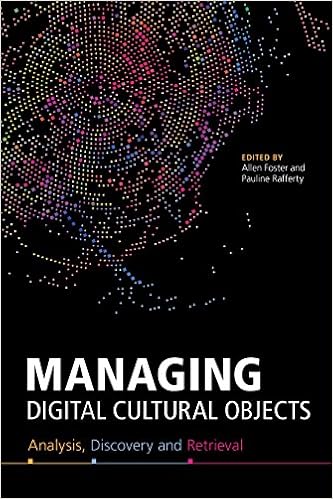
Managing Digital Cultural Objects


Foster, Allen and Pauline Rafferty (eds.) Managing Digital Cultural Objects: Analysis, Discovery and Retrieval. Neal-Schuman, 2016. ISBN: 978-0-8389-1343-7

Description
This collection of essays explores the issues involved in the retrieval of a variety of non-textual objects, including image, music, and moving image.Case studies of digitization projects drawn from practitioners within libraries and information organizations showcase both technical and more strategic issues relating to cultural heritage projects, digital asset management and sustainability.

Table of Contents

Introduction - Pauline Rafferty and Allen Foster

Part 1: Analysis and retrieval of digital cultural object management

1. Analyzing digital cultural objects: putting it in context - Pauline Rafferty
2. Metadata models and digital cultural objects - Sarah Higgins 
3. Digital traces of user-generated content - Katrin Weller
 
Part 2: Digitization projects in libraries, archives and museums: case-studies
 
4. Visual digital humanities: National Library of Wales - H. M. Dee,  L. M. Hughes, G. L. Roderick and A. D. Brown
5. Managing and Preserving Digital Collections at the British Library - Maureen Pennock and Michael Day
6. Preserving digital audio material - Will Prentice
 
Part 3: Social networking and digital cultural objects
 
7. Photos: Flickr, Facebook and other social networking sites - Corinne Jorgensen 
8. Searching and creating affinities in web music collections - Nicola Orio  
9. Film retrieval on the Web - Katherine La Barre

Thursday, August 25, 2016

The Wiki Way of Learning


The Wiki Way of Learning: Creating Learning Experiences Using Collaborative Web Pages by Michele Notari, Rebecca Reynolds, Samuel Kai Wah Chu, and Beat Döbeli Honegger. American Library Association, 2016.

Given the limited budgets of schools, educators, and school librarians, free and open source tools for learning are more important than ever. Essentially, wikis are easily accessible webpages for creating, browsing, and searching through information, making them ideal vehicles for teaching and collaboration. In this pathbreaking collection, theoreticians and practitioners from a range of international settings explore how wikis are being used to create learning experiences in a variety of educational environments, from grade schools through universities. 

Offering numerous hands-on examples of using collaborative webpages with learners, this book gives teachers, educators, and instructor librarians
·        a theoretical overview of the concept of web-based collaboration and the social implications of the participative web written by Mark Guzdial, a pioneer in using wikis in education;
·        an understanding of how wiki-engines function as a flexible tool for collaboratively creating, linking, revising and regrouping hypertext content;
·        pragmatic guidelines for the educational use and application of wikis, including applications as e-learning management systems, informational resource libraries, online tutorials, maker community project creation, and digital asset file management; 
·        strategies for setting up a learning unit the “Wiki Way” and choosing the most appropriate and suitable wiki-engine in a particular education setting; and
·        coverage of two different scaffolding models for learning scenarios which have been implemented and tested in the US, Switzerland, Hong Kong, and China.

Enabling readers to see how wikis’ content and content creation processes can be harnessed for instructional design, this collection represents an important advance in improving education through collaborative technologies.

For more information on this title, see the publisher’s web page.

Local Community in the Era of Social Media Technologies

Local Community in the Era of Social Media Technologies by Hui-Lan Titangos. Chandos Publishing, 2013.

Social media technologies can help connect local communities to the wider world. Local Community in the Era of Social Media Technologies introduces the experience of bringing a local community to the world. This book, with the model of Santa Cruz County, California, develops a truly global approach to the subject. The first section of the book covers the early efforts of recording the local Santa Cruz area, before moving on to deal with Library 1.0. The next section looks at the present situation with Library 2.0 and its benefits. The book ends with a discussion of future directions and the implications of Library 3.0 and beyond.

Covers:
  • Illustrates the potential for new developments through practical experience
  • Goes beyond digitization technology to include: integrating database management; using library professionals’ unique research skills; conferencing and publications; and rejuvenating Library 1.0 applications
  • Demonstrates how to effectively present local information to the world
Visit the publisher’s web page for the table of contents and more.

Wednesday, August 24, 2016

Exploring Discovery

Exploring Discovery: The front door to your library's licensed and digitized content edited by Kenneth J. Varnum. American Library Association, 2016. 978-0-838-9-1414-4.

We’re in a new age of Discovery. Not of the physical world but rather one that serves up appropriate resources for your library’s researchers, thanks to advancements in handling metadata, natural language processing, and keyword searching. For you, Discovery might be shorthand for single-index products such as Serials’ Solutions Summon, EBSCO Discovery, and OCLC’s WorldCat Discovery. Yet even those tools require adjustments to meet your institution’s specific needs. With first-hand profiles of 19 library projects, Varnum and his roster of contributors offer guidance on the complete range of discovery services, from the broad sweep of vendors’ products to the fine points of specialized holdings. Topics include:
  • migrating from a traditional ILS to a library services platform;
  • creating a task list for usability testing of discovery;
  • managing internal development requirements within the constraints of a small or mid-sized library;
  • applying agile software methodology to a Blacklight implementation;
  • real-world examples of usability testing, including a small liberal arts college’s implementation of VuFind;
  • meeting the challenge of three different metadata formats;
  • practices in the Primo community for integrating open access content into the front end;
  • serving mobile users with an app and responsive Web design;
  • analyzing the use of facets in search;
  • using a single discovery tool across a library, museum, and archive; and
  • implementing discovery with geospatial datasets.
Easy to dip into as needed, this comprehensive examination of discovery services will prove invaluable to IT, web development, electronic resource management, and technical services staff.

Visit the publisher's web page for the table of contents and more.

The Patron-Driven Library

The Patron-Driven Library: A practical guide for managing collections and services in the digital age by Dee Ann Allison. Chandos Publishing, 2013. 978-1-84334-736-1.

Libraries in the USA and globally are undergoing quiet revolution. Libraries are moving away from a philosophy that is collection-centered to one focused on service. Technology is key to that change. The Patron Driven Library explores the way technology has moved the focus from library collections to services, placing the reader at the center of library activities. The book reveals the way library users are changing, and how social networking, web delivery of information, and the uncertain landscape of e-print has energized librarians to adopt technology to meet a different model of the library while preserving core values. Following an introduction, the first part begins with the historical milieu, and moves on to current challenges for financing and acquiring materials, and an exploration of why the millennial generation is transformational. The second part examines how changes in library practice can create a culture for imagining library services in an age of information overflow. The final chapter asks: Whither the library?

Covers:
  • Provides a synthesis of current research on the impact of technology on behavior, and connecting it with library services
  • Offers examples and practical advice for incorporating technology to meet user expectations and assess services
  • Suggests management techniques to overcome barriers to change and technology innovation

  • Visit the publisher's web page for the table of contents and more.