Monday, September 26, 2011

Going Mobile


Going Mobile: Developing Apps for Your Library Using Basic HTML Programming, by Scott La Counte, Chicago : American Library Association, 2012.52p.

From the ALA website:
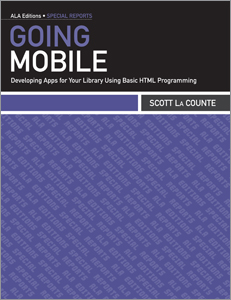
Patrons increasingly expect access to their libraries anywhere, anytime.  This Special Report provides practical guidance in how librarians can put the library in the palms of their patrons’ hands. Using the HTML skills that many librarians already have along with flexible development tools, technology expert La Counte shows how creating a customized mobile app doesn’t need to be expensive or require deep expertise.  In straightforward, practical terms he:
  • Demonstrates how to establish a presence on the mobile web with mobile websites and phone apps
  • Details open-source development tools such as PhoneGap that allow for the creation of mobile apps that work on a variety of mobile operating systems, with emphasis on the iPhone
  • Discusses methods for assessing a library’s user base and getting buy-in from administrators
Following the pointers in this Special Report, libraries can easily go wherever their patrons do!

Table of Contents 
Introduction   
1    Before You Begin  
2    Developing a Mobile Web Application      
3    Using CSS  
4    JavaScript and Mobile Website Design      
5    PhoneGap  
6    Building Your First Native App  
7    Beyond the Basics  
8    Other Ways to Go Mobile  
Appendix

About the Author

Scott La Counte is a librarian at Anaheim (Calif.) Public Library. He is the author of the book Quiet, Please: Dispatches from a Public Librarian (Da Capo Press, 2008), which began as a series for McSweeney’s Internet Tendencies. He teaches writing online for the Gotham Writers’ Workshops. His iPhone app, LibFind, gives the addresses and phone numbers of public libraries across the United States.

Monday, September 19, 2011

. Measuring Library Performance: Principles and Techniques


Brophy, Peter. Measuring Library Performance: Principles and Techniques. London: Facet, 2006. 025.58 Broph isbn 978-1-85604-593-3

Measuring library performance requires multiple perspectives and various methods of evaluation. Brophy's innovative approach ensures that user's opinions, economic factors, and staff input are all taken into account. He demonstrates how both traditional and electronic services can be evaluated and helps professionals learn to gather data; quantify outputs; evaluate systems; and utilize benchmark, standards, and balanced scorecard methods of evaluation. There is also advice for leveraging findings for staff training and development. With a start-to-finish approach, this manual will help you evaluate and improve your library effectively.

E-metrics for Library and Information Professionals: How to Use Data for Managing and Evaluating Electronic Resource Collections


White, Andrew C. and Kamal, Eric Djiva. E-metrics for Library and Information Professionals: How to Use Data for Managing and Evaluating Electronic Resource Collections. New York: Neal-Schuman, 2006. 025.284 White isbn 1-55570-514-6

Designed to introduce readers to e-metrics ("the measurements of the use and activity of networked information"), this book is made up of 10 chapters that are divided among three major sections. Part 1 supplies a definition of e-metrics, explores their use in libraries, and discusses vendor-supplied electronic data reports. Part 2 explains why libraries need e-metrics, focusing on how they can be used for public relations, collection management, and library administration. Part 3 offers ways that libraries can build local e-metrics. Chapters cover the capturing and processing of statistics, infrastructure and technical requirements, and staffing needs. With its coherent structure, well-articulated language, and illustrative material (tables, figures, and examples), this book has much to recommend it. The authors are successful in elucidating a subject that may seem daunting and abstract to the uninitiated. Overall, an important resource for all librarians and information professionals.

Wednesday, September 7, 2011

Books Challenged or Banned in 2010-2011 (supplement)

Doyle, R.P. (2011). Books Challenged or Banned in 2010-2011. Chicago, IL: American Library Association.

The annual supplement to the Banned Books Resource Guide contains information on recent bans, challenges, and successes in libraries and schools nationwide. Banned Books Week highlights the benefits of free and open access to information while drawing attention to the harms of censorship by spotlighting actual or attempted bannings of books across the United States.

For more information about Banned Books Week, please visit http://www.ala.org/bbooks.

8.5" x 11"
11 pages

(supplement description)

Thursday, July 21, 2011

Working in the Virtual Stacks: The New Library & Information Science


Kane, Laura Townsend. Working in the Virtual Stacks: The New Library & Information Science. Chicago: ALA, 2011. 020.2373 KaneW
ISBN 978-0-8389-1103-7


Thanks in part to technology, the boundaries of library positions are dissolving. It is no longer practical to discuss the profession in terms of traditional library types, and in today's library, the relationship between librarians and technology is stronger than ever. In this informative volume, veteran author Kane interviews dozens of practicing librarians who are highly involved with technology as part of their day-to-day jobs. Revealing the full richness of the profession, Kane


  • Profiles web-services librarians in all types of settings, from veterinary medicine and law to astronomy, market research, and cataloging

  • Offers insights into career opportunities in the library world by challenging traditional notions of what a librarian does

  • Shows examples of real-world librarianship in the fields of technology instruction, digital futures, virtual libraries, and even librarians as entrepreneurs

  • Written in a warm and personal style, Working in the Virtual Stacks presents an exciting future for librarians, already upon us today!