Monday, May 24, 2010

Building Science 101: A Primer for Librarians


Piotrowicz, Lynn M. and Scott Osgood. Building Science 101: A Primer for Librarians. Chicago: ALA, 2010. 022.31 Piotr ISBN 9780838910412

Take care of your library and it will take care of you! In this practical, concise volume the authors provide a tour of the library building from foundation to roof. In a time of rapidly inflating energy prices and tight public budgets, many libraries are faced with older physical facilities that are not up to modern standards of efficiency. Designed for libraries where construction of a whole new building is not feasible, this book offers step-by-step instructions for 1) improving energy use of existing structions 2) identifying ways to enhance building maintenance 3) investing resources for future savings.

Negotiating Licenses for Digital Resources


Durrant, Fiona. Negotiating Licenses for Digital Resources. London: Facet, 2006. 346.4207 Durra. ISBN 1856045862

With the increasing availability of digital resources, it is vital for those involved in purchasing them to get to grips with the complexities of contracts, costs and the relationships that exist between subscriber and publisher. "Negotiating Licences for Digital Resources" is a practical guide on how to get the best deal for online subscriptions. The processes outlined in this book can be applied to a wide range of electronic products, ranging from e-journals to multi-modular databases. There are practical tips and guidance on what to focus on during the course of the negotiation and, most importantly, what preparation is needed to ensure that you gather the necessary amount of information to achieve the best outcome. The text guides you logically through the stages of negotiation, from initial awareness of your organization's needs to making the contract more understandable, and offers advice on the skills and techniques of negotiation, whether in written or face-to-face scenarios. This book can act as a reference tool for experienced negotiators, or as a primer for those who have never before been involved in the process. It is essential reading for information professionals, knowledge managers, online resource buyers and procurement officers across all sectors, and will also be of interest to publishers, e-journal agents and vendors of online resources.

Serving Lesbian, Gay, Bisexual, Transgender, and Questioning Teens: A How-To-Do-It Manual for Librarians


Martin, Millias J. Jr. and James R. Murdock. Serving Lesbian, Gay, Bisexual, Transgender, and Questioning Teens: A How-To-Do-It Manual for Librarians. New York: Neal-Schuman, 2007. 027.63 Marti ISBN 978-1555705664

This volume takes on the challenge of providing library services to LGBTQ teens. In a clearly laid-out format and a highly readable style, the guide focuses on helping queer teens within the larger umbrella of providing service to all teens. Part 1 covers library service to the LGBTQ population. Understanding the queer community and identifying LGBTQ teens' informational needs, offering effective service in a safe environment, handling readers'-advisory and reference interviews, doing collection development, integrating LGBTQ themes into general programming, and assesssing and responding to the rate of change and inclusion a community will tolerate are all covered in an accessible manner. Part 2 consists of an excellent annotated bibliography as well as sample booktalks and instructions for program design. An additional source bibliography and a fine index complete a superior tool for starting or enhancing library services to a formerly neglected subset of the teen population.

Developing and Maintaining Practical Archives: A How-To-Do-It Manual; a How-to-Do-It Manuals for Libraries, Second Edition


Hunter, Gregory S. Developing and Maintaining Practical Archives: A How-To-Do-It Manual; a How-to-Do-It Manuals for Libraries, Second Edition. New York: Neal-Schuman, 2009. 027 Hunte 2nd ed. ISBN 978-1555704674

If you have to do archives, this is a very good book. Eminently practical and readable, it discusses everything from undertaking a records survey to issues involved in electronic archives. An extensive bibliography presents many articles by leaders in the archival profession. Extremely useful are charts that organize important information succinctly?for example, characteristics of records with intrinsic value and a convenient table providing cubic foot equivalents for physical items. Anecdotal vignettes such as Alex Haley at the National Archives and Stanford University's purchase of Allen Ginsberg's manuscripts and "old electric bills" make for lively reading, sharpening what Richard Cox once called "the cutting edge of a dull profession." Hunter, an associate professor at the Palmer School of Library and Information Science, Long Island University, was the first president of the Academy of Certified Archivists and is a former chair of the Society of American Archivists' Committee on Education and Professional Development. Highly recommended for those just starting out and as a useful refresher for established archivists as well.

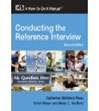
Conducting the Reference Interview; A How-To-Do-It Manual for Librarians 2nd edition


Ross, Catherine Sheldrick, Kirsti Nilsen and Marie L. Radford. Conducting the Reference Interview; A How-To-Do-It Manual for Librarians 2nd edition. New York: Neal-Schuman, 2009. 025.52 Ross 2nd ed. ISBN 978-1555706555

This second edition is completely updated, with an all-new section on virtual reference. The section on the readers’-advisory interview is now a full chapter. Marie Radford joins authors Ross and Kirsti Nilsen, bringing her expertise and research on virtual-reference services. All three authors have been involved in large and long-term research projects on reference and readers’-advisory interviews, virtual and face-to-face, and their work informs all chapters of this book. Scenarios based on real library transactions illustrate many important ideas, and most also include comments and discussion questions, making it easy to adapt them for classes or workshops. Sidebars appear on nearly every page, with “Did you know?” research facts, short exercises, and “Quick Tips.” This outstanding work is highly recommended for all libraries and is essential reading for all LIS educators and librarians involved in staff training.